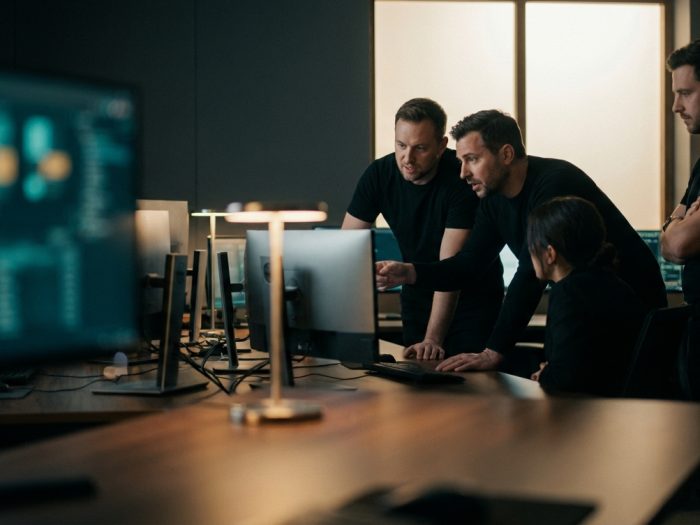
In many security teams, major incidents are still handled by whoever shouts loudest in the war room, rather than by an incident response specialist who owns clear playbooks and orchestrates the entire effort.
This pattern survives because responsibility for incidents is usually fragmented across security operations, infrastructure, application teams and occasionally legal and communications. Each team owns part of the puzzle, yet no single role is accountable for stitching detection, triage, containment and recovery into one coherent sequence. When an alert escalates into a real incident, the question is not only what to do, but who decides, who signs off business impact, and who keeps everyone aligned. In that vacuum, senior engineers or the CISO step in as ad-hoc coordinators, which works once or twice, then breaks at scale.
Tool sprawl and alert fatigue make this worse. Most organisations have multiple logging platforms, endpoint tools, network controls and ticketing systems that all light up when something goes wrong. Each team watches its own screens and pushes tickets into someone else’s queue, hoping they will pick them up. Coordination cost explodes, and the result is improvised conference calls, parallel chats and duplicated work. When everyone is partially responsible and nobody owns the playbook, response depends on goodwill and overtime instead of a defined operating model.
Trying to solve this purely with in-house hiring runs into structural constraints. Hiring cycles for experienced incident responders are slow, competitive and frequently misaligned with the urgency of current risks. Even when the headcount is approved, the market offers many generalist security engineers and relatively few specialists who have actually led complex incidents end to end. Internal hiring also tends to favour broad roles that cover operations, engineering and occasional response, which dilutes the focus on building and maintaining rigorous runbooks.
Building a complete internal response capability requires more than one strong hire. Effective incident handling needs depth in forensics, containment strategy, communication management, regulatory impact assessment and post-incident improvement. Most organisations never reach this critical mass. They hire one or two people and expect them to cover every time zone, every incident type and every executive update. Those specialists quickly become overloaded. They spend their time firefighting rather than codifying repeatable processes, and the organisation slides back to reliance on ad-hoc heroics from whoever is available.
Classical outsourcing and generic managed security services also fail to close this gap. These providers typically focus on monitoring, ticketing and predefined containment actions, not on owning the end-to-end response inside your environment. They generate alerts, sometimes even high-quality ones, but when a real incident unfolds they escalate back into your organisation, expecting internal teams to coordinate. The MSSP handles its queue. Your teams handle theirs. Nobody is accountable for the whole incident lifecycle.
The lack of deep context further limits external providers. Without intimate knowledge of your assets, business processes, data flows and internal politics, a third party struggles to make confident containment decisions or to manage stakeholders. SLAs tend to measure response time to alerts, not the quality of coordination or the clarity of decisions taken under pressure. The result is either over cautious advice that slows containment, or aggressive actions that disrupt business unnecessarily. In both cases, you still end up relying on internal heroes to interpret guidance, mediate between provider and business, and improvise the real response.
When this problem is solved properly, incident response is a disciplined operational rhythm, not an emergency scramble. A named incident response specialist owns the playbooks, keeps them aligned with your architecture and risk appetite, and drives regular tabletop exercises so that no one encounters the process for the first time during a live breach. The war room is not a chaotic call where people argue over logs. It is a structured environment where roles are clear, communication cadences are defined and decisions follow a known path.
Tooling is integrated around the incident workflow rather than around individual products. Alerts from different systems converge into a single response process with clear triage criteria, escalation paths and evidence handling. The specialist knows where to pull which artefacts, how to stage forensics without contaminating evidence, and how to engage legal or compliance at the right moment. Post-incident reviews feed directly back into updated runbooks and minor architectural changes, closing the loop instead of producing forgotten slide decks. Time to contain improves, not because people work harder, but because the system is predictable.
Team Secure’s cybersecurity staff leasing model for an incident response specialist is built to drop this operating discipline into your organisation without asking you to dismantle what already works. The specialist is contracted through Team Secure yet embedded into your security organisation, plugged into your existing SOC, infrastructure teams and governance forums. They are not a remote black box. They sit inside your decision structure, participate in your change management and understand how your environment actually behaves.
Structurally, work is governed through jointly defined playbooks, clear RACI matrices and agreed communication flows that tie together your teams and Team Secure’s broader capabilities. The leased specialist owns the day-to-day response rhythm, while having direct access to Team Secure’s wider expertise and SaaS tools for deeper investigation, automation and evidence management. This combination preserves your visibility and control, keeps accountability unambiguous and brings in the specialised depth that is rarely feasible to build quickly in-house. Over time, the organisation stops relying on late night heroics and instead runs incidents with the same Swiss-quality discipline it expects from any other critical business process.
Most security teams still depend on improvised heroics during incidents because no specialist owns the playbooks and coordination, in-house hiring alone cannot assemble the required depth fast enough, and generic outsourcing or MSSPs lack the context and integration to run real-world response. Team Secure’s staff leasing model for incident response specialists replaces that pattern with embedded, accountable ownership, using Swiss-quality, enterprise-grade execution that combines cybersecurity services, staff leasing and SaaS tools to cover the full incident lifecycle. To see how this would operate in your environment, request a security assessment or a short discovery call with our team.